A restaurant postcard only needs 1 to 5 replies per 100 homes to count as a win. That’s the benchmark Mail Processing Associates, a mailing company, gives for mail sent to every home on a route.
So restaurant direct mail marketing isn’t about flooding every mailbox in town. It’s about picking the right homes, printing one offer worth leaving the house for and counting what comes back.
Get those 3 things right and a few hundred postcards can tell you whether mail belongs in your marketing.
What Is Restaurant Direct Mail Marketing?
Restaurant direct mail marketing is sending printed pieces, such as a postcard, a menu or a coupon, through the mail to people who live near your restaurant. It’s a form of direct mail advertising and direct marketing, and its job is simple: get a nearby household to try you, or get a past guest to come back.
You can address it 2 ways.
You can blanket whole neighborhoods with Every Door Direct Mail (EDDM), a USPS service that drops one piece at every address on the carrier routes you choose. Or you can mail named people from a list, such as past customers from your own database or new movers.
Either way, your offer lands in a mailbox people check every day, not a feed fighting for every consumer’s attention. That’s the big difference from digital marketing like social posts and email.
Does Direct Mail Still Work for Restaurants?
Direct mail still works for restaurants when the card reaches homes close enough to visit and carries a clear offer. Mail Processing Associates, a mailing company, calls a 1-5% response rate generally successful, though it varies with your target area and household income.
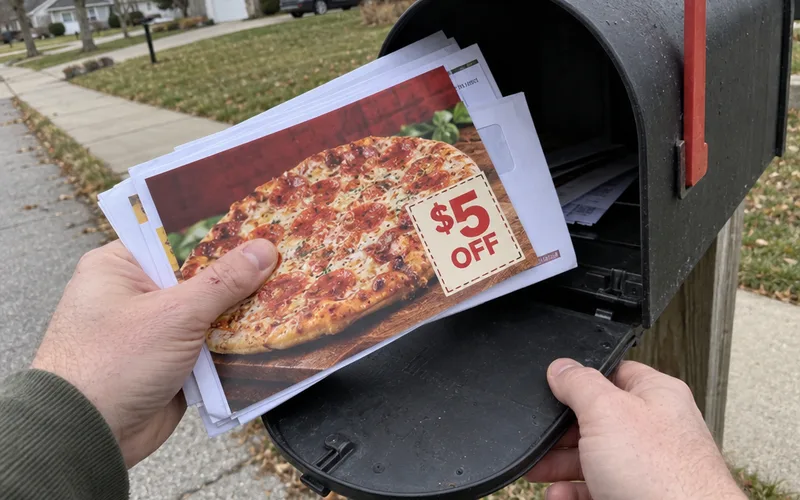
So if you mail 1,000 homes, 10 to 50 replies is a normal result.
That might sound small. But each reply is a nearby household that has never eaten with you.
What a Great Result Looks Like
PostcardMania, a postcard printer, published a case study on Piccadilly Restaurant in Baton Rouge, LA. Piccadilly mailed 5,000 postcards in six separate mailings, received 2,313 responses and generated $27,756 in revenue on a $2,523 spend.
PostcardMania calls that a 1,000% ROI.
Treat it as one vendor’s best case, not your forecast. Plan your budget around the normal benchmark, and count anything above it as a bonus.
Should You Use EDDM or a Mailing List?
EDDM fits a restaurant that wants new diners from the neighborhood, and a mailing list fits one that wants to reach specific past guests by name. Mail Processing Associates, a mailing company, says EDDM uses no mailing list at all, while targeted mail to named customers needs an addressed, CASS-certified list.
Here’s how the 2 compare side by side:
| EDDM | Addressed mailing list | |
|---|---|---|
| Who gets it | Every active address on your routes | Only the names on your list |
| List needed | No | Yes, CASS-certified |
| Best for | New neighbors, openings, new menus | Past customers, win-backs, birthdays |
For most independent restaurants, EDDM is the easier first step, because there’s no list to buy or clean up before you mail. Targeted marketing to a list built on demographics or past visits can come later.
How EDDM Works
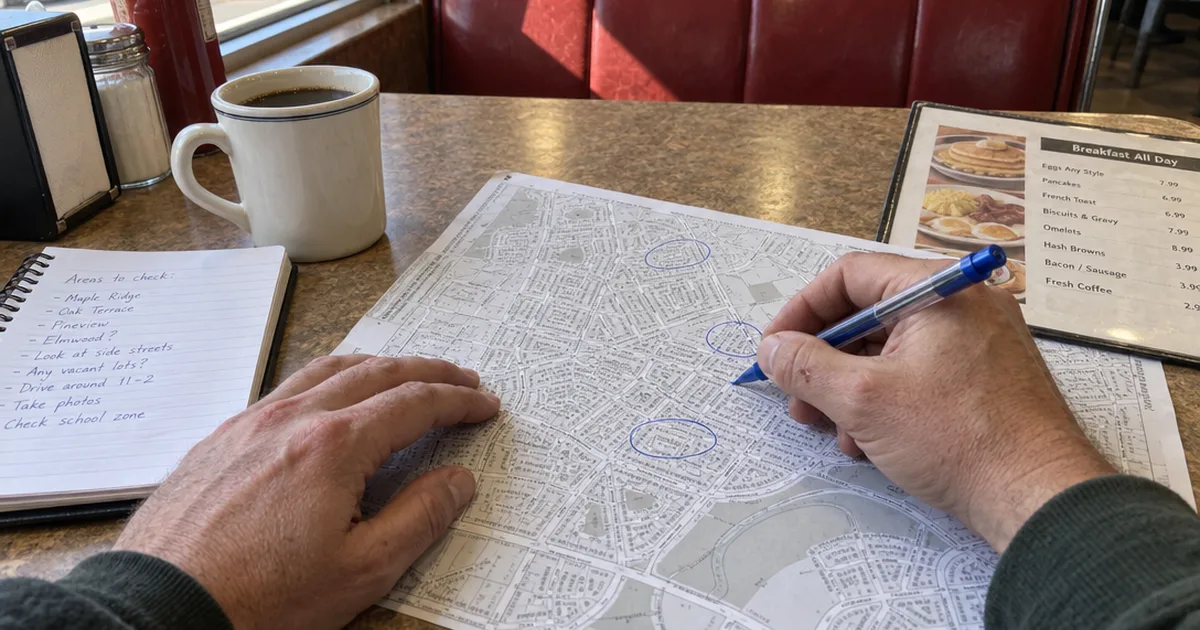
With EDDM, you pick USPS carrier routes near the restaurant on a map, and USPS delivers your piece to every home on them. According to the same company, the minimum is one full carrier route or 200 pieces, and EDDM Retail allows up to 5,000 pieces per day per ZIP code.
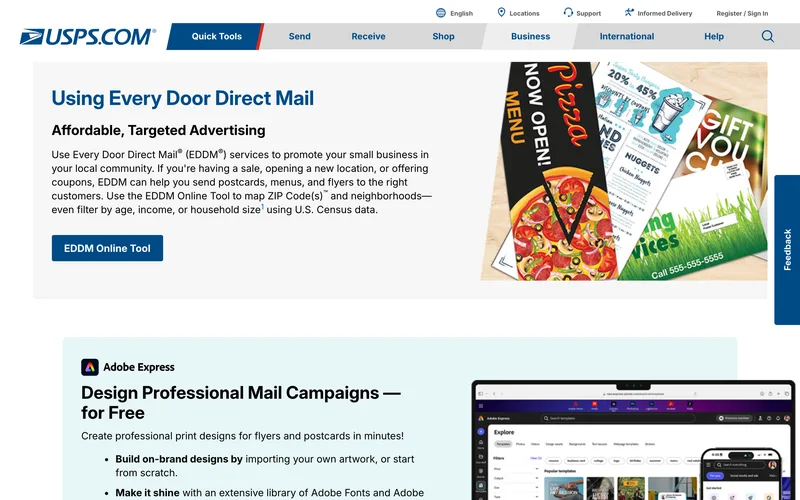
That’s plenty for a single location. The click-by-click steps for booking routes are in the walkthrough on how to mail flyers to a neighborhood.
When a Mailing List Is Worth It
A list makes sense when you already know who you want back, like customers from your reservation book or loyalty program. The catch is that addresses go stale fast.
Alec Boye, President of Mail Processing Associates, puts it plainly: “We catch 6 to 9 percent of records moved on a typical commercial list, sometimes 12 percent on lists older than 18 months.”
In other words, an old list means paying postage to people who moved.
How Much Does Restaurant Direct Mail Cost?
Restaurant direct mail costs about 50 cents a postcard all-in, based on PostcardMania’s Piccadilly case study. That campaign mailed 5,000 cards for $2,523, and printer pricing will move with card size, paper, quantity and routes.
Here’s what that means for a first test (hypothetical numbers):
- Mail 2,000 cards at about $0.50 each, for roughly $1,000.
- At a 1% response, 20 households come in. At 5%, it’s 100.
- If each visit brings a $25 check, that’s $500 to $2,500 in revenue.
So the low end loses money on the first visit, and the high end pays for the mailing twice over.
That’s why a postcard has to earn repeat visits, not just one meal.
Before you order, set the number in your restaurant marketing budget. Then compare the cheapest direct mail marketing options for your card size.
What to Put on a Restaurant Postcard
A restaurant postcard needs one offer, one appetizing food photo, your address and hours, an expiration date and a tracking code or QR code. That’s the core of any direct mail piece that gets someone to try a new place.
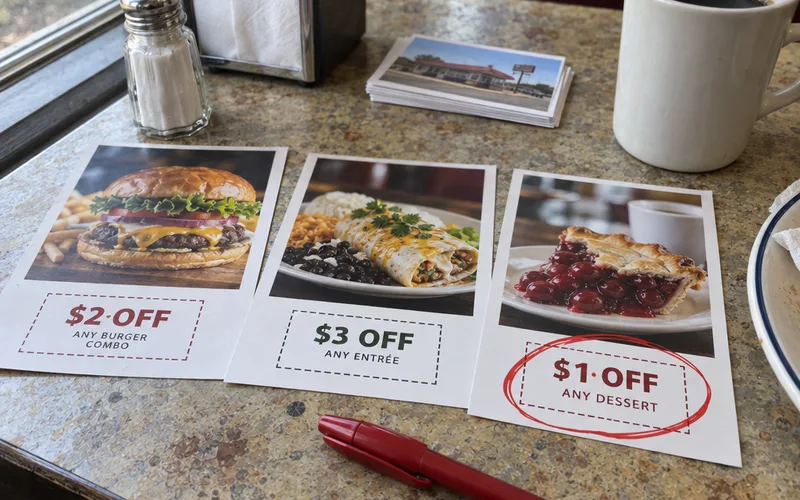
Here’s the checklist I’d use before printing:
- One offer. A free appetizer with an entree beats a list of 5 deals.
- One hero photo. Good food photography sells, so show your signature dish close up and in good light.
- Contact information, big. Address, hours, phone and a landmark (“next to the post office”).
- A deadline. An expiration date a few weeks out gives people a reason to act now.
- A way to count. A coupon code, short URL or QR code unique to this mailing, pointing to a simple landing page.
Put your logo and brand colors in a corner, and keep the headline short enough to read from the curb. If you need wording ideas, borrow from your menu specials or your best restaurant specials ideas.
Note: Skip the full menu on a postcard. A crowded design hides the offer and the call to action, and those are what bring people in.
6 Restaurant Direct Mail Ideas That Fill Seats
The best restaurant direct mail ideas tie one offer to one moment, like a grand opening, a slow weeknight or a guest who stopped coming. Pick the moment first, then write the card for it.
Here are 6 that suit a diner, pizzeria, taqueria or casual dining spot:
- Grand opening invite. Mail every route within a short drive with an opening-week offer. Pair it with your grand opening event ideas.
- Slow-night special. A Tuesday family pizza deal, a weekday lunch combo or a Happy Hour offer, valid only at your quiet times.
- New menu launch. One photo of the new chicken plate and a “try it free with any meal” message.
- New-neighbor welcome. Mail new movers a “welcome to the neighborhood” card with a first-visit gift.
- Holiday and catering. Land a catering menu before office party season or a Holiday pre-order card before Thanksgiving.
- We-miss-you card. Mail past customers from your own list a free dessert or a small gift card to come back.
Rotate 2 or 3 of these through the year instead of reinventing the card every time.
How Long Does Direct Mail Take to Arrive?
USPS in-home delivery for EDDM typically runs 7 to 14 business days after the mail is dropped, according to Mail Processing Associates. The same company advises approving artwork roughly three weeks before a dated event.
Printing happens before the drop, so count backward from the day you want the card in hand.
Late mail can sink a good offer. Put the drop date on your restaurant marketing calendar the same day you plan the promotion.
How to Track Responses and ROI
You track restaurant direct mail by giving each mailing its own coupon code or QR code, then counting redemptions at the register. Divide replies by pieces mailed for your response rate, and compare the sales they brought in with what the mailing cost.
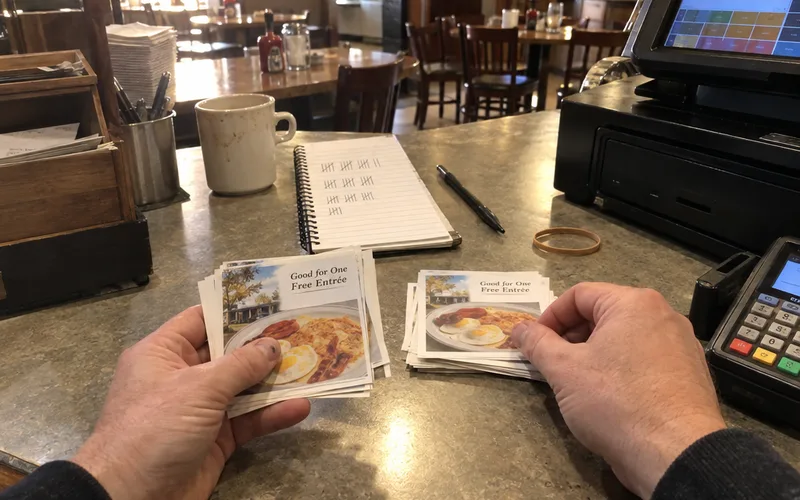
Comparing those sales with the cost gives you your return on investment.
Here’s the simple version:
- Response rate: 30 coupons back from 2,000 cards is 1.5%.
- ROI: (revenue from coupons minus mailing cost) divided by mailing cost.
Use a different code for each route or each design. That way you’ll have real data on which neighborhood or offer pulled its weight, and you can drop the ones that didn’t.
Key Takeaway: A mailing without a code is a guess. Track restaurant marketing ROI the same way for every channel so you can compare them fairly.
How to Turn Mailer Visits Into Regulars
A mailer earns its money when a first-time guest comes back, and a loyalty program is the easiest way to make that happen. Hand every guest who redeems a postcard a punch card on the spot, so the next visit already has a reason.
A digital punch card in Apple Wallet or Google Wallet works well here, because it lives on the phone guests already pulled out to scan your QR code. Set one up with the steps in the punch card guide.
You can also print a sign-up link on the receipt. A QR code on the receipt lets a new guest join your rewards or text list before they’ve even left the table.
The postcard earns the first visit, and the loyalty card gives the guest a reason to make it a habit.
Start With One Route This Month
Direct mail works best as a small, tracked test, not a one-time blast.
Pick the 1 or 2 carrier routes closest to your door, choose one offer for your slowest night and send it with its own code and a clear call to action. Then browse more restaurant flyer ideas to design the next card around whatever wins.
Frequently Asked Questions
What is a direct mail marketing strategy?
A direct mail marketing strategy is a plan for who gets your mail, what offer it carries, when it lands and how you count the replies. For a restaurant, that usually means a few carrier routes near you, one strong offer, a delivery date timed to a slow week and a code on every card.
What are some examples of direct mail marketing?
Common examples of direct mail marketing for restaurants are postcards with a coupon, mailed menus, grand opening invitations, new-neighbor welcome cards and win-back cards sent to past guests. Pick the one that matches your goal, then put a single offer and a tracking code on it.
How many postcards should a restaurant send?
A restaurant using Every Door Direct Mail must send at least one full carrier route or 200 pieces, according to Mail Processing Associates, and EDDM Retail caps a day’s drop at 5,000 pieces per ZIP code. Start with the routes closest to your door, then add more once a mailing pays for itself.