Getting started
·
·
10 dk okuma
Start a small business loyalty program that survives a rush
A small business loyalty program comes down to three decisions: what earns credit, how far the reward sits, and how a customer joins without slowing the queue.

Andrew Kim
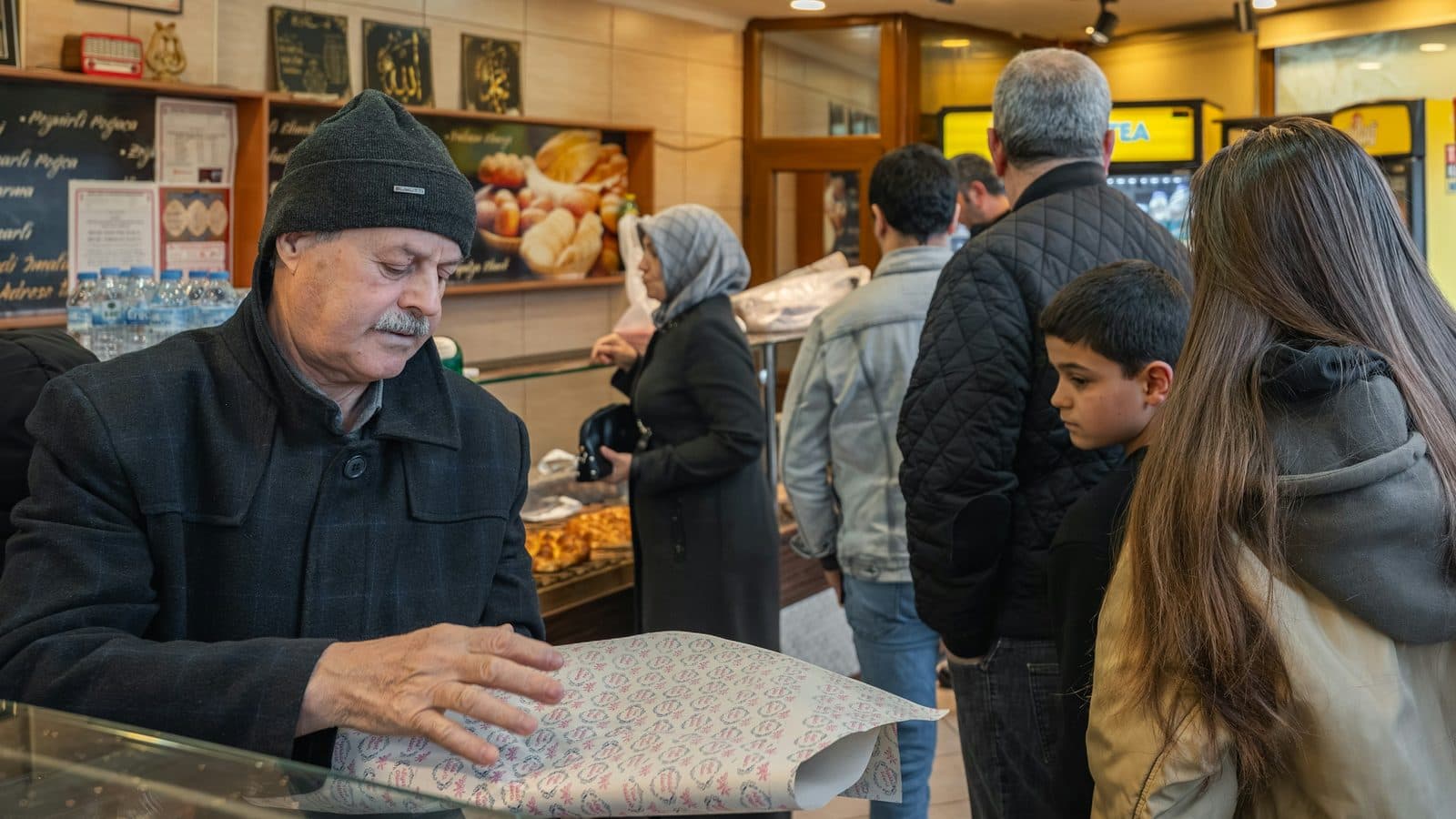
Photograph by Yasin Onus on Unsplash
Mystery shoppers placed 753 orders at the counters of ten national quick-service chains this year. Nobody greeted 27.9% of them. These are companies with training departments, printed scripts, and a budget for secret shoppers to go and check whether the scripts are being used.
A small business loyalty program depends on something similar happening at your counter, a few hundred times a week, while the same person is also making the drink. Nobody writes about that part. Every guide to starting one goes from "define your goals" straight to "choose a platform", and when SumUp asked 617 US small business owners in November 2025 why they had no program, 26.9% of the quick-service restaurants among them said they simply did not know how to implement one.
A loyalty program is a standing rule that gives a returning customer something back. Three decisions settle one for a small business, and all three are made before you sign up for anything: what earns a customer credit, how far away the reward sits, and how somebody joins in the seconds a queue allows. None of them is which software you buy. That part can be free.
Three decisions settle a small business loyalty program
| Decision | What works behind one counter | What rules the rest out |
|---|---|---|
| What earns credit | A visit, or a dollar spent | Anything needing partners, an app store, or a pricing analyst |
| How far the reward sits | Eight to twelve purchases, reachable within a month or two | A bar most of your customers will never clear |
| How a customer joins | One scan at the counter, nothing to install, no account to create | A download, a paper form, or a card they have to remember to carry |
The right-hand column is the one that costs money to get wrong. Each entry there is a choice you can only undo by relaunching the program in front of customers who have already learned the old rules. Starbucks paid for that in public. In April 2016 it stopped counting visits and started counting dollars, and its regulars worked out inside a day what had just happened to them.
What earns credit, and how far the reward should sit
The first decision comes off your till receipts rather than out of your preferences. Look at the spread. If a typical ticket sits within a couple of dollars of every other ticket, count visits, and if a $45 trim and a $220 balayage both walk through the same door, count dollars, because one stamp card pays both the same reward and quietly runs a deeper discount for your cheapest customer.
Distance is the second. Put the reward eight to twelve purchases out and it stays reachable for somebody who comes twice a week, while the cost of the free item spreads across enough paid ones to stop mattering. Set it at three and you have written a standing 33% discount for the regulars who were coming anyway. We worked through what that reward actually costs, and who ends up collecting it, and the arithmetic is unkind to short cards.
Both of those are an afternoon's work, and the third one is the rest of this article.
Sign-up is where a small business loyalty program actually dies
EY asked more than 1,600 US consumers where they last enrolled in a loyalty program, for its 2025 Loyalty Market Study. A company website took 35% of them and a brand's own mobile app took 30%, which between them is nearly two-thirds of everyone who joined anything. The store checkout counter took 16%.
Now read it from your own till. You do not have a website with a rewards section, and you are not going to ship an app, so the counter has to carry every enrollment you will ever get. Nationally it is the weakest of the three.
EY also asked what made them join. Getting a reward on the purchase they were already making came first at 58%, a members-only discount second at 50%, and an easy, convenient sign-up process third at 36%. A suggestion from a store employee finished sixth of seven, at 11%.
That ordering is your design brief. Put the offer on the transaction happening right now, while the customer is standing at the counter with a wallet already open and thirty seconds in which they can be handed something.
Then there is the app question. The evidence pulls two ways here and it is worth saying so out loud: EY found that over 80% of consumers say they would download a mobile app for a loyalty program, with 60% calling themselves very or generally likely to do it. A Harris Poll run for Wilbur in June 2019 caught the opposite mood, with 58% of Americans saying an app requirement made them less likely to join and 76% saying they were more likely to join a program that asked for nothing but a name and a phone number.
Both readings can hold. Willingness to install Starbucks is not willingness to install the cafe on the corner, and EY's panel was answering about the programs they already belong to, which skew national. A wallet pass steps around the argument entirely, since Apple Wallet and Google Wallet are already on the phone and a pass drops into one of them from a single scan. Here is what that looks like from the customer's side.
Nobody is going to ask every customer
Back to the mystery shoppers. Across those 753 counter visits at ten national chains, staff offered an add-on 60.6% of the time, and the strongest brand in the study reached 78.4%. Intouch Insight ran 75 shops per brand for its 2026 On-Premises Study, across breakfast, lunch and dinner.
None of that blames the people working. It is what one extra sentence is worth when it has to compete with a queue, a card reader, a timer, and the order after this one.
Put your own counter through it. At forty transactions an hour, the best rate in that study still leaves nine people an hour who never hear the sentence, and the study average leaves sixteen. Over a fifty-hour week those gaps add up to several hundred people who were never offered the thing, and not one of them will mention it to you.
So build the path that does not depend on anyone remembering. EY's own recommendation to its clients is in-store signage, "such as through QR codes for signups while customers wait to check out", which is the rare piece of consultancy that costs one sheet of paper. The sign asks the whole queue. Staff only have to catch the people who did not read it.
Then write one sentence, use the same words every time, and pin it to a fixed moment rather than to good intentions. Pick the card reader. You are both standing there for four seconds anyway, and a sentence spoken into that gap costs the queue nothing at all.
The phone number you collect is not free
Most sign-up forms ask for a phone number, and most of the reason is that the business intends to text people later. That is regulated. In the United States the rules around it tightened while almost nobody outside the compliance industry was watching, and they tightened again this spring.
The FCC's order on revoking consent, adopted in February 2024 and in force since 11 April 2025, lets a customer withdraw consent to marketing texts by any reasonable method, and requires the sender to honor it "not to exceed ten business days" from receipt. The word stop works. So do quit, end, revoke, opt out, cancel and unsubscribe, and the order says plainly that other wording counts too whenever a reasonable person would read it as an opt-out. The provision making one opt-out cover every kind of message from the same sender was delayed by a year and has been live since 11 April 2026.
Underneath sits the statute itself, which lets a consumer sue for $500 a message and up to $1,500 where a court finds the violation willful.
One rule you may have read about never arrived. The FCC's one-to-one consent requirement, which would have demanded separate written consent for every seller a customer might hear from, was vacated by the Eleventh Circuit on 24 January 2025 in Insurance Marketing Coalition v. FCC, one business day before it was due to take effect.
Weigh that against what people want. In the same EY survey, 59% named email as their preferred way to hear from a loyalty program and 13% named text, so all that record-keeping buys you the channel one customer in eight actually wants.
A wallet pass is a third thing. A notification pushed to one goes to the pass sitting on the phone rather than as a text to a telephone number, so the rules above are not what governs it. None of this is legal advice, and if you intend to build a texting list, an hour with a lawyer costs less than the first complaint.
What a free loyalty program for a small business covers
Free is a real option here, and it is also where the fine print lives. Every free plan caps something: active customers, locations, staff logins, or whether you can message anybody at all. Find the cap first. It is the number you will actually hit, and you will hit it long before you exhaust the feature list it sits under.
Ours holds 200 active customers at one location, with wallet passes, card design and the printable counter page included, and push notifications kept for the paid plans. The pricing page carries the rest. Loyalty Cards is our product, so read that paragraph the way you would read any company describing itself.
The genuinely free version is a paper card and a rubber stamp, and it does work. It cannot tell you anything. A paper card has no way of knowing that somebody joined in March and stopped coming in April, which is the exact fact the next section sends you looking for.
What to check after ninety days
Member count is the first number every dashboard shows you and close to the least useful. The research is blunt about why. The people who bother to join are disproportionately the ones already coming, so a long member list mostly measures which of your customers were already regulars.
Two numbers repay the trouble of tracking them.
Start with your enrollment rate, which is cards issued divided by transactions across an ordinary week. Take it from the till. That one grades the sign-up path, and it is the half of this you can still do something about before the month is out.
Then go back to whoever joined in your first thirty days and count how many of them returned within the following thirty. That is the real test. A healthy enrollment rate sitting next to a poor return rate means the reward is too far away, and if both are poor then the sign-up is the problem, and no reward is generous enough to rescue it.
Put the sign-up on the counter
Loyalty Cards gives you a print-ready page for the till, so a customer can scan the QR code while they wait and the card saves straight to their wallet. One location and 200 customers are free.
Kaynaklar
- 2025 EY Loyalty Market Study · Ernst & Young LLP, 2025
- An Intouch Insight Study on the In-Person QSR Guest Experience · Intouch Insight, 2026
- 2026 On-Premises Study: What's Changing in QSR In-Person Experiences · Intouch Insight, 2026
- 73% of Small Businesses Still Operate Without Loyalty Programs, SumUp Survey Finds · SumUp, 11 December 2025
- Survey: Consumers Less Likely to Join a Loyalty Program That Collects Personal Data or Requires an App · Total Retail, 3 June 2019
- Rules and Regulations Implementing the Telephone Consumer Protection Act of 1991, FCC 24-24 · Federal Communications Commission, February 2024
- FCC partially delays new TCPA consent revocation rules · Nixon Peabody, 11 April 2025
- The TCPA's New Opt-Out Rules Take Effect on April 11, 2025 · Bryan Cave Leighton Paisner, 2025
- Eleventh Circuit Vacates TCPA 1:1 Consent Rule · Kelley Drye, January 2025