Getting started
·
·
10 min de lectura
A restaurant loyalty program should count dollars
A restaurant loyalty program should count dollars, not visits: one stamp pays the same for a $14 solo lunch and a $90 dinner for four.

Andrew Kim
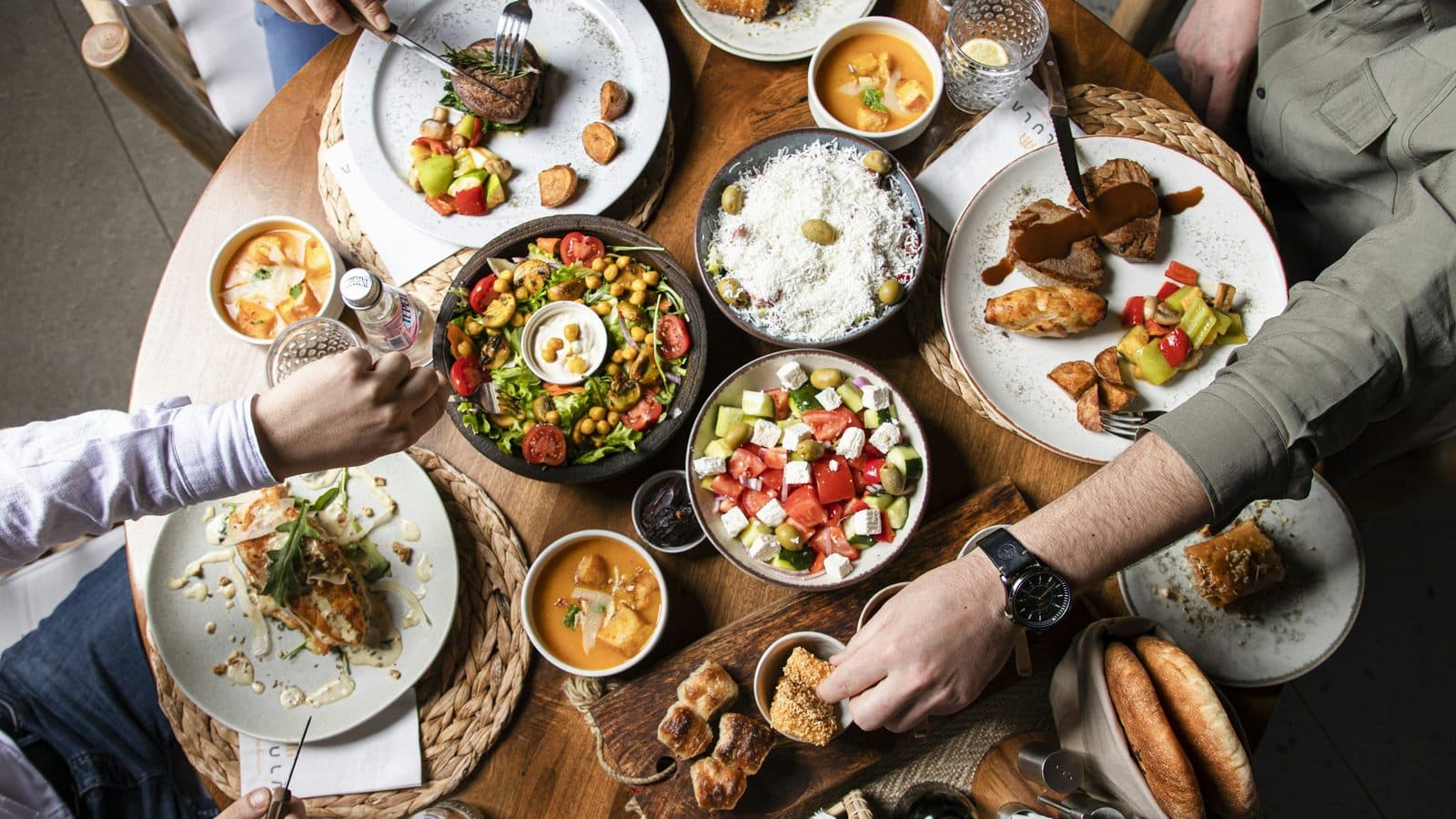
Photograph by Aurela Redenica on Unsplash
A full-service restaurant turning over less than $2 million a year kept a median of 1.1% of sales before tax in 2024, in figures the National Restaurant Association drew from more than 900 operators' books. That is a penny on the dollar. Whatever a restaurant loyalty program gives away has to fit inside it.
Every guide to starting one skips the question that decides whether it fits. They tell you to set goals, pick a reward, shop for software and promote it at the table, and not one of them says what a guest has to do to earn anything. That is the whole design.
Count dollars, not visits. A restaurant loyalty program should award points for every dollar a guest spends rather than a stamp for every time they walk in, because one stamp lands the same on a $14 solo lunch and a $90 dinner for four. There's an exception, and I'll come back to it.
A restaurant is not a cafe, and the arithmetic breaks twice
Most of the advice restaurants get is cafe advice wearing a bigger apron, and it comes apart in two places. Both are about money.
Start with what you keep. The 1.1% above is for full-service restaurants under $2 million in sales, and crossing that line changes it: the same survey puts income before taxes at a median of 4.3% for the bigger ones. We priced a loyalty reward against a cafe's 13.8% net margin in an earlier piece, and a card that looked cheap there is a different animal against a penny.
The reward costs more too. A full-service restaurant under $2 million spent a median of 33.7% of sales on food and non-alcohol drinks in 2024, against 31.0% for restaurants above the line and 32.0% across full-service respondents as a whole. Give away a $16 main and about $5.40 walks out of your kitchen, which is roughly five times what a free latte costs a cafe while the margin absorbing it is about a twelfth the size.
The same card costs six times as much depending on who fills it
Here is one ten-visit card, a free $16 main at the end, and four guests who each did exactly what the card asked of them.
| Guest | Average check | Collected over 10 visits | Reward at food cost | Reward as a share of what you collected |
|---|---|---|---|---|
| Weekday lunch, alone | $14 | $140 | $5.39 | 3.9% |
| Dinner, alone | $22 | $220 | $5.39 | 2.5% |
| Dinner for two | $45 | $450 | $5.39 | 1.2% |
| Dinner for four | $90 | $900 | $5.39 | 0.6% |
The reward is costed at 33.7% of a $16 menu price, the median food cost for a full-service restaurant under $2 million in sales.
Read the last column. The card hands your cheapest guest a 3.9% discount and your most valuable one 0.6% for identical loyalty, which is roughly the reverse of what the program was built to do.
Against the 1.1% that restaurant was keeping, the lunch guest's reward costs more than three times the profit their visits were producing. The big table barely notices.
That gap exists for a reason specific to restaurants. A visit is not a person. The check covers the table, so one stamp lands whether a guest came alone for soup or brought five people for a birthday, and only one of them is holding the card.
One more thing the table assumes: that the free main went to a guest who wouldn't otherwise have come. Often they would have. If that Friday booking was happening anyway you didn't give away ingredients, you gave away the sale, and the lunch row climbs from 3.9% to 11.4%.
Points remove the spread without any cleverness. Set a give-back of 3% and every guest gets 3%, whatever they order and however many of them turn up.
Domino's counts orders, and its chief executive named the flaw
The clearest evidence that per-visit counting misprices a restaurant comes from the largest chain still doing it.
Domino's Rewards gives 10 points for every order of $5 or more, and 60 points buys a medium two-topping pizza. Restaurant Dive did the arithmetic when that version launched in September 2023: "a $5 order earns the equivalent of 2 points per dollar, while a $20 order earns half a point per dollar." Four times the rate, from one rule.
None of that was an accident. Chief executive Russell Weiner told analysts before the rollout that "one of the things that's going to be true in the new loyalty program is we're going to recognize that a carryout customers' ticket is lower, and so the hurdle for getting points will be lower." A chain can choose to overpay small tickets on purpose, because it wants carryout volume and can price that choice across its whole system.
You have one dining room. Chipotle, which counts the other way, gives 10 points for every dollar spent with a free entree sitting at 1,625 points, so the reward arrives after $162.50 of spending whether that took five visits or twenty. I checked both numbers on 24 August 2026, and they do move: the April 2026 relaunch added lower thresholds and stretched expiry from six months to a year.
Your most frequent guests are not reliably your biggest
Underneath every per-visit card sits a comfortable assumption, which is that the guest who turns up most often is worth the most. Restaurant data disagrees. In fast food, at least, it disagrees flatly.
PAR Technology's 2026 QSR Operational Index, built from more than 30,000 quick-service restaurants and 149 million loyalty guests in 2025, found that "super users" with more than ten visits a year drive 61% of check-ins but 53% of sales. Their share of the visits beats their share of the money, which happens only when their average check sits below everyone else's, so a program counting visits pays them most while collecting least from each trip. The heaviest users are the cheapest tables.
The same report put loyalty members at $15.08 a visit against $14.82 for anonymous guests. That is twenty-six cents. Every vendor in this category sells the idea that members spend more, and in the largest quick-service dataset published this year they do, by about the price of a napkin.
Full-service data points somewhere else, and the disagreement is worth carrying rather than resolving. The Regulars Report 2026 from Resy and Toast, published on 4 June 2026, found that up to half of a restaurant's order volume can come from just 7% of its guests, and its survey of 1,500 US diners suggests regulars order more freely once they trust a kitchen. Fast food regulars reorder. Restaurant regulars sometimes trade up.
Your own till already knows which of those you have. Pull the average check for your twenty most frequent guests and set it against everybody else's, which takes an evening and answers the question for your dining room rather than for the industry. Do that before you set a rate.
The checks a restaurant loyalty program never sees
A counting rule only reaches transactions the program can identify, and restaurants lose more of those than most small businesses do, through two holes that are both wide enough to matter. Neither is fixable with software alone.
Third-party delivery is the expensive one. In PAR's data it carried the highest average check of any channel at $22.73, running 61% above the all-channel average, with a delivery premium of 78% at breakfast and 49% at dinner. Those orders arrive without a guest you can recognize, which is why Domino's said plainly that its Uber Eats orders would earn and redeem nothing.
The in-room hole is worse than most owners expect. Chipotle has an app, 21 million active members and years of practice, and it reported in April 2026 that while nearly 90% of its digital transactions are linked to Rewards, only about 20% of in-restaurant transactions are. One in five. Its answer was menu panels, table tents, cup printing and a crew incentive tied to sign-ups, which is the same problem waiting at every small business counter with a marketing budget thrown at it.
Counting dollars softens this. A missed stamp costs a guest 10% of their card. A missed $22 check costs them $22 out of a few hundred, which is irritating rather than the kind of loss that makes somebody stop bothering with the card at all.
When a stamp card is still the right answer for a restaurant
Not every restaurant should count dollars. If your checks cluster, count visits: a slice counter where nearly everyone buys two slices and a soda, a taqueria whose cheapest and priciest orders sit three dollars apart, a breakfast place with one real order on the menu. The mispricing the table above measures barely exists in those rooms, and a stamp card is easier to explain, easier to run in a queue and easier for a guest to picture.
Test it rather than guessing. Pull last month's checks, find the middle one, then find the check a quarter of the way up the list and a quarter of the way down. If those two sit within a couple of dollars of each other, stamps are fine, and the simplest structure that fits is usually the right one. If the upper one is double the lower one, your card is a discount whose rate is set by whoever happens to be holding it.
Deloitte's guidance on restaurant loyalty is the first thing most owners find, and it argues for moving from transactional rewards toward experiential and emotional ones: exclusive access, priority service, personalized offers. Its own 2022 survey found 86% of members rate the plain transactional benefits as important, and it tells brands to be strong there before adding anything on top. That order is the useful part.
For a chain with a loyalty team, the rest of that spectrum is a roadmap. For one dining room it's a distraction, because the transactional layer is the entire program and choosing between points and stamps is the whole job. Get that right first.
Set the give-back rate before you print anything
Work backwards from a percentage you can pay, rather than forwards from a reward that sounds generous.
- Pick the share of loyalty revenue you're willing to hand back. Two to three percent is defensible against a 1.1% to 4.3% margin, and anything above that assumes the program is genuinely bringing people through the door.
- Price the reward at food cost, not menu price. A $16 main at 33.7% costs you about $5.40.
- Divide. At 3%, that $5.40 of reward should arrive after $180 of spending.
- Turn it into something a guest can read. Ten points a dollar with the reward at 1,800 points is the same rule, and it beats "spend $180" for the reason a punch card beats a spreadsheet.
Then check the result against something real. Chipotle releases an entree at $162.50 of spending as of 24 August 2026, so a rule that releases a $16 main at $60 is a standing 9% discount with a card attached.
One thing the arithmetic won't give you. In that Resy and Toast survey, nearly half of diners said being remembered by the staff is what makes them feel most valued, more than double the share who named points or rewards, and only 30% said they get that consistently. Nobody is asking for a card. Pricing one correctly won't buy you the thing your guests actually wanted, but it will stop the thing you can afford from quietly eating a margin this thin.
Count what the table actually spends
Loyalty Cards can count points on spend instead of visits, so the Friday table for four earns what it actually spent rather than one stamp. Starting is free for one location and 200 active customers.

Fuentes
- Higher volume restaurants reported lower food-cost ratios in 2024 · National Restaurant Association, 16 October 2025
- Restaurant operators kept food cost ratios in check in 2024 · National Restaurant Association, 10 September 2025
- Domino's boosts rewards points with new loyalty program · Restaurant Dive, 13 September 2023
- Chipotle Rewards · Chipotle Mexican Grill, Checked 24 August 2026
- Chipotle relaunches Rewards with "Rewards on Repeat" · Chipotle Mexican Grill, 13 April 2026
- 2026 QSR Operational Index Report · PAR Technology, 21 April 2026
- The Regulars Report 2026 · Resy and Toast, 4 June 2026
- Unlocking the value of loyalty programs for restaurants · Deloitte